
The Antikythera Mechanism is a hand-cranked bronze device, built in ancient Greece more than two thousand years ago, that tracked the movements of the Sun, Moon and calendar cycles using a train of precisely cut gears. Often called the world’s first analog computer, it could model the heavens in miniature, predicting the phases of the Moon, the timing of eclipses and the rhythm of festivals and games. Nothing else like it survives from the ancient world.
Its story begins in 1901, when sponge divers hauled corroded lumps of bronze from a shipwreck near the Greek island of Antikythera. It took generations of study, and eventually X-ray imaging, to reveal the intricate machinery hidden inside. The question that follows is a good one: how did anyone in antiquity build something this sophisticated, and what does it tell us about how people read the sky?
That question matters well beyond Greece. Every culture, including the Indigenous peoples of Turtle Island, developed its own deep knowledge of sky cycles, seasons and celestial timekeeping. The mechanism is one remarkable expression of a very human impulse.
In this article, we’ll take a virtual journey inside the device, turn its dials, and see how it worked. If you enjoy exploring the past through technology, our guide to virtual heritage VR shows how digital tools are bringing historic places and objects to life.
What the Antikythera Mechanism Means: An Ancient Greek Analog Computer in Plain Language
Who Made It, and When?
No one signed it. No workshop name, no maker’s mark, and no ancient writer who describes the machine has survived, so the craftsmen behind the Antikythera Mechanism remain unknown. What we have is the object itself, and it points to a skilled team rather than a lone tinkerer. Cutting dozens of tiny, precise gear teeth and engraving the finest inscriptions took trained hands and a deep knowledge of the sky.
That knowledge had deep roots. The device draws on the astronomical traditions of the wider Greek world, which in turn inherited long records of sky-watching from earlier cultures. If you want the wider setting, our overview of Ancient Greece history shows how learning, trade and travel moved ideas around the Mediterranean. Scholars have floated various candidates for where it was built, but none has been confirmed.
Dating is just as careful work. Researchers generally place its construction in the Hellenistic era, the last few centuries before the Common Era. The shipwreck that carried it offers one clue, but a ship’s loss date does not tell us when its cargo was made, and the debate over a more exact range continues. The honest answer is a window of time, not a single year.
A Story from the Sea: Finding and Studying the Wreck’s Mysterious Bronze
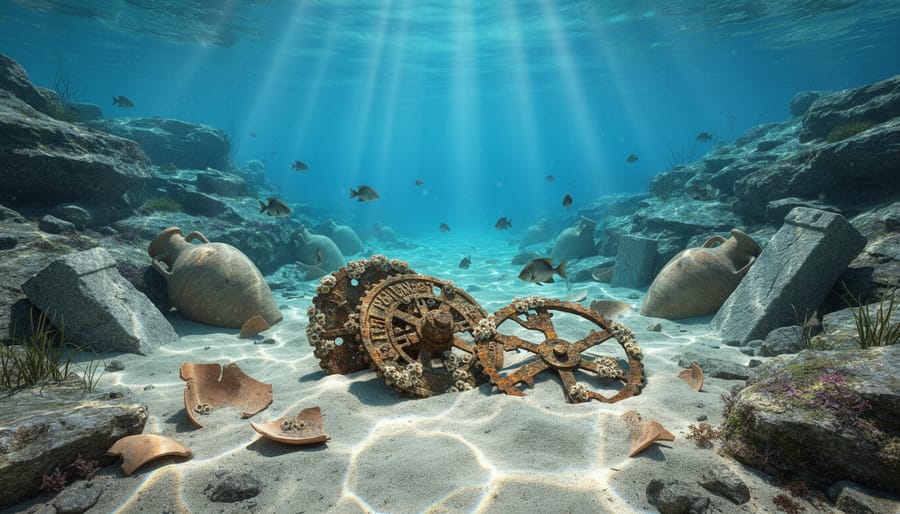
In the spring of 1900, a group of Greek sponge divers sheltered from a storm near the tiny island of Antikythera, between Crete and the Greek mainland. One of them, diving deep to look for sponges, surfaced in a panic. He had seen what looked like a heap of corpses and horses on the seabed. What he had actually found was an ancient shipwreck, its cargo of bronze and marble statues scattered across the sand.
The divers returned with an arm from a bronze statue, and the recovery of the wreck’s treasures stretched into 1901. Among the crates of statues and pottery came something that looked like nothing at all: a corroded lump of bronze, crusted over after roughly two thousand years underwater. It went into storage with everything else, and for a while nobody paid it much attention.
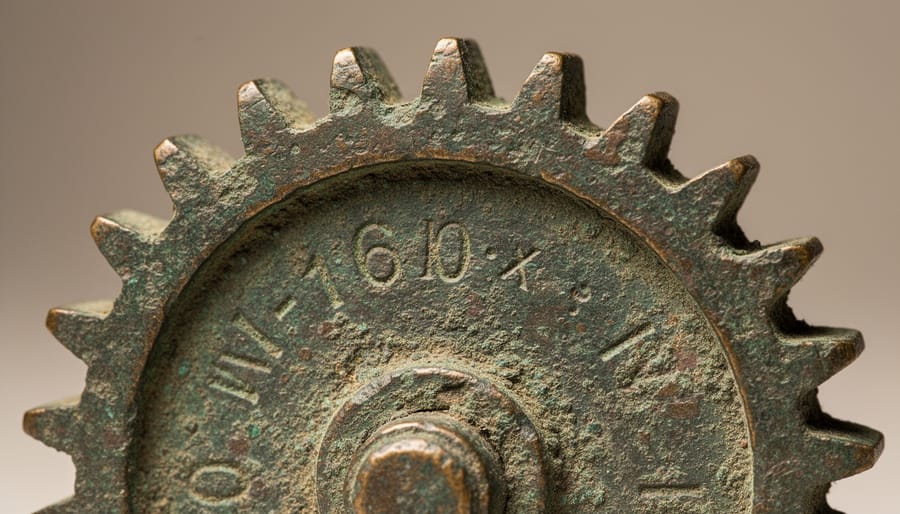
Then the lump cracked open. It split into fragments, and a visible gear wheel and tiny engraved letters hinted that this was no ordinary scrap. Even so, the first scholars could only guess at what they were holding. The pieces sat in the National Archaeological Museum in Athens for decades, studied slowly and argued over by a handful of patient researchers.
The real breakthrough came with new ways of seeing inside the metal. X-rays in the twentieth century revealed gear teeth hidden beneath the corrosion. Later, advanced CT scanning in the early 2000s let researchers peer through the fragments layer by layer, uncovering fine inscriptions and counting individual teeth. Piece by piece, a puzzle emerged: a hand-cranked machine of interlocking gears.
What stands out about this story is how ordinary the first chapter was. The mechanism wasn’t found by a grand expedition but by working divers hunting sponges, with the support of local knowledge of the sea. It’s a pattern that repeats around the world, including here in Canada, where local residents, hunters and community members often spot the traces of a region’s most important heritage long before the experts arrive.
How the Antikythera Mechanism Works: Gears, Dials and a Turning Crank

Picture holding a replica in your hands. It’s a wooden box about the size of a shoebox, with a small crank on its side. As you turn the handle, a gear inside nudges the next one, and that one nudges another, until the whole bronze train comes to life. On the front, a pointer creeps across a calendar scale. Turn faster, and you’re racing through the months. Turn it backward, and you’re rewinding time.
That is the heart of how the Antikythera Mechanism works. Every turn of the crank advances a date, and the gears translate that single motion into the slower, more complicated rhythms of the sky. One pointer follows the sun through the zodiac. Another tracks the moon, and researchers have long noted that it even shows the moon’s phases. The ancient builders packed dozens of toothed wheels into a case small enough to carry, each one cut by hand.
The clever part is the cycles. Think of a wall calendar or a tide table: both work because nature repeats itself in predictable patterns. The Greeks knew this too. The Metonic cycle is a stretch of 19 years after which the moon’s phases return to the same calendar dates, which is handy for keeping a lunar calendar in step with the solar year. The Saros cycle, about 18 years, is a pattern in which eclipses tend to recur under similar conditions. Rather than calculating from scratch, the machine had these repeating cycles built right into its gear ratios. Turn the crank, and the cycles play out in miniature.
So how well did it work? Honestly, it was a stunning achievement for its time, and nothing else like it is known from the ancient world for centuries afterward. But it wasn’t perfect. The sun and moon don’t move at perfectly even speeds, and the mechanism approximated those variations with clever gearing rather than exact mathematics. Over time, small errors would have crept in. Because only corroded fragments survive, researchers also can’t be certain how every gear fit together, and scholars are still testing models to see how closely the original matched the heavens.
If you’d like to see these ideas in motion, reconstructions let you try the crank yourself, a theme we’ll return to when we look at the Kotsanas Museum exhibit listed for 2026.
Dials, Gears and Inscriptions: The Parts of an Ancient Computer
Picture the device as a wooden-cased box about the size of a shoebox, with a dial on each face and a crank at the side. Inside, dozens of small bronze gears mesh like the works of a very early clock. Turn the crank, and the whole sky seems to move in miniature.
Here are the main parts researchers have identified:
- The front dial shows the zodiac and the Egyptian calendar, with pointers for the sun and moon.
- The upper back spiral tracks the Metonic cycle, a calendar pattern that lines up lunar months with solar years.
- The lower back spiral follows the Saros cycle, used to flag possible eclipses.
- Smaller back dials counted other cycles, including the timing of athletic festivals.
- The gear trains link everything, so one turn of the crank moves every pointer in step.
Then there is the writing. Inscriptions cover the plates and cases, and scholars describe parts of the text as a kind of instruction manual. It explains what the dials show and how to read them, much like a label inside a modern gadget. Without it, we would be guessing far more about what the maker intended.
Here is the catch: only fragments survive. Centuries underwater left the bronze corroded and broken into pieces, so no one has seen a complete original. Researchers fill the gaps with careful reconstruction, using imaging of the fragments to infer missing gears and dials. That is why working replicas, like the reconstruction listed under the Kotsanas Museum of Ancient Greek Technology (2026), are so valuable. They let you see how the pieces may have fit together, even while scholars keep debating some of the details.
What Was It Used For? From Calendars and Eclipses to Teaching the Skies
So what was this machine actually for? Nobody can say for certain, and that’s part of its charm. Scholars read the evidence differently, but a few uses come up again and again.
The most practical job was keeping time. Greek city-states ran on different local calendars, and reconciling months with the solar year was a real headache. Turn the crank, and the dials show where you are in the cycle, a bit like a very elaborate pocket almanac.
Then there are eclipses. The back spirals appear to flag the months when a lunar or solar eclipse was possible. For a culture that often read the sky as a message, being able to anticipate one was no small thing.
Another detail feels wonderfully human. The dials also seem to track the cycle of major games, including athletic festivals, the kind of event that drew people together from across the Greek world. Think of it as a sporting calendar built from bronze gears.
Beyond the practical, some researchers suggest it served as a teaching tool, a way to show students how the heavens moved. Others see a prestige object, something a wealthy owner might display to impress guests with a miniature cosmos. Probably it was a bit of each, and the honest answer is that its exact purpose is still interpreted and debated.
It’s worth remembering that tracking the sky was never a Greek monopoly. Indigenous peoples across Canada built deep, careful knowledge of seasons, stars and lunar cycles, using it for navigation, ceremony and survival. Their methods and meanings differ widely from nation to nation, and from this Greek device. Still, the shared thread is the same: people watched the heavens closely, because their lives depended on understanding them.
Seeing a Reconstruction for Yourself: The Kotsanas Museum Exhibit and Hands-On Experiences
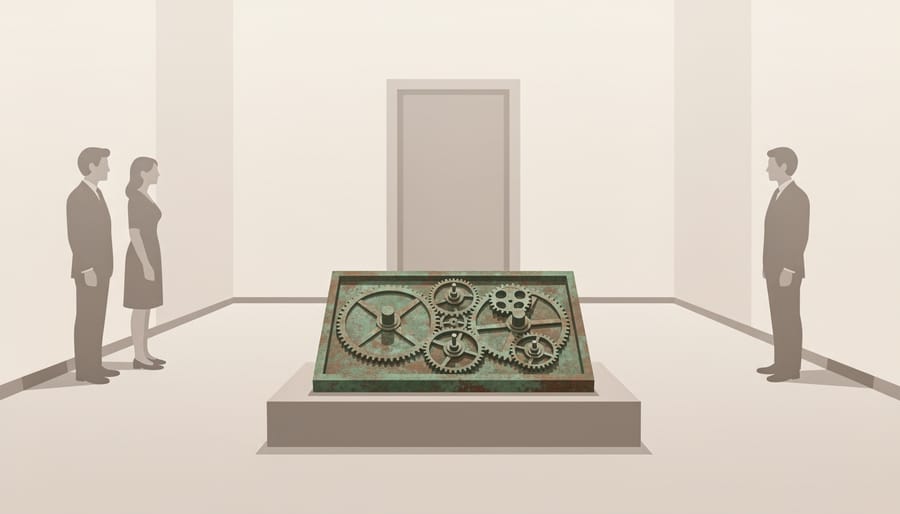
Reading about a corroded bronze machine is one thing. Watching a reconstruction turn is another, and a few current listings suggest ways to do it.
The most relevant one appears under the Kotsanas Museum of Ancient Greek Technology (2026), with its location shown as Calgary, Canada, and an association with February 2026. You can find the details in the Kotsanas museum exhibit listing. Related listings go further, describing a private tour and tech workshop for 2026, plus an Athens-based STEM experience titled “Build the First Computer.”
Why do these matter? Because the original fragments are fragile and sit behind glass. A working reconstruction lets you do what no museum visitor can do with the real thing: turn the crank, watch the gears mesh, and see the pointers creep across the dial. That hands-on moment is where the idea of an ancient analog computer finally clicks.
A few practical notes:
– The listings confirm the names and the 2026 timing, but I can’t confirm every detail of what each session includes.
– The ticket price is not confirmed, so please check with the organizer for current dates, availability, and costs before planning a trip.
If you can’t travel, you still have options. Many virtual field trips bring heritage collections to your screen, and it helps to know how to get more from an interactive museum exhibit even when you’re viewing it remotely.
Common Questions About the Antikythera Mechanism
Readers keep asking the same handful of things about this bronze machine, so here are straight answers, including where the experts themselves still disagree.
What is the Antikythera Mechanism?
It is a hand-cranked device of interlocking bronze gears recovered from a shipwreck near the Greek island of Antikythera. It modelled the movements of the sun, the moon and the calendar, which is why it is often called an ancient Greek analog computer.
What did it do?
Turn the crank and the gears advanced a date while pointers tracked the sun and moon. It also followed cycles used to anticipate eclipses and to keep calendar and festival timing in step.
Who designed it, and when was it made?
Nobody knows who built it, and no signature has survived. Scholars generally place it in the Hellenistic era, but the exact date and workshop remain debated.
How well did it work?
It was an extraordinary instrument for its time, packing complex astronomical cycles into a compact case. Researchers still study its accuracy, and because only fragments survive, some of its limits are reconstructed rather than proven.
Notice how often the honest answer is “scholars are still working on it.” That open-endedness is part of the draw, and it is the same curiosity that makes even a small piece of ancient history trivia feel like a doorway into a whole lost world.
If you would rather see the idea in motion than read about it, reconstructions do exist. A listing from the Kotsanas Museum of Ancient Greek Technology (2026) shows an exhibit with Calgary, Canada, as its location and February 2026 as its timing, and related listings describe a private tour and tech workshop. Ticket price is not confirmed, so check with the organizer before planning a visit.
A lump of corroded bronze shouldn’t hold anyone’s attention for long. Yet the Antikythera Mechanism does, because it carries a quiet reminder: people two thousand years ago looked up, watched the sun, moon and stars with real patience, and built something to hold what they had learned. Gears were their way of sharing a way of seeing the sky.
That impulse isn’t unique to one place or era. Across Canada, Indigenous peoples have long tracked seasons, stars and lunar cycles for navigation, ceremony and survival, passing that knowledge along through story, practice and place. Different tools, the same curiosity about the heavens.
If this journey has sparked your interest, keep going. Visit a heritage site near you, look for places that share Indigenous astronomical knowledge, and ask questions. Many sites and museums offer tours and workshops that make the past feel close enough to touch.
And for site managers and educators: consider what a hands-on exhibit could do for your own story. Let visitors turn a crank, trace a pointer, or watch a model move, and a faded artifact becomes an experience. The Antikythera Mechanism endures partly because we can imagine ourselves working it. Heritage that people can handle, question and wonder about tends to stay with them long after they leave.
