
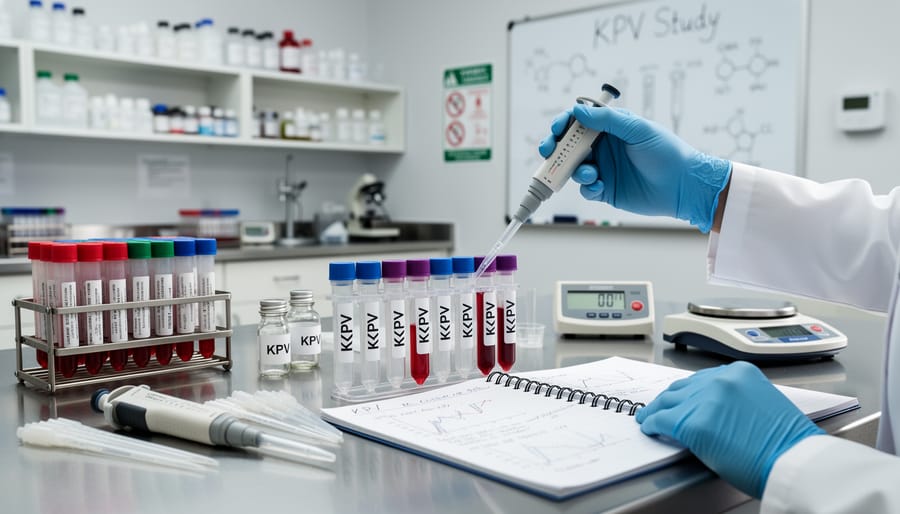
KPV is a tripeptide, a tiny chain of three amino acids (lysine, proline, valine) that makes up the tail end of alpha-melanocyte-stimulating hormone, a signaling molecule the body already produces. Researchers study it because that fragment appears to carry anti-inflammatory activity on its own, without the pigment-related effects of its parent hormone. Suppliers now sell KPV tripeptide vials for laboratory research. In lab models, KPV has been linked to a quieter inflammatory response, including reduced activity in pathways such as NF-kB, a master switch that tells cells to ramp up inflammatory signals.
Think of the research as a guided tour through a very small landscape. Much like those virtual field trips that let you walk through a distant place from your desk, studying KPV means tracing a route through cells, signals, and tissues you can’t see directly, one stop at a time. That availability has made the peptide easier to find than it is to fully understand.
That gap matters. Most of what we know comes from cell cultures and animal studies, not large human trials. This article reviews what those studies suggest about inflammation pathways, where the evidence is thin, and what questions remain open. It’s educational, not medical advice.
What KPV Means: A Tiny Peptide With a Long Research Story
Think of a peptide as a very short protein: a chain of amino acids, the building blocks the body uses for almost everything. Most proteins run to hundreds of links. A peptide might have only a handful. KPV has exactly three, lysine, proline and valine, which is where its name comes from (each letter is the standard shorthand for one amino acid).
Its story starts with a larger hormone. Researchers studying the melanocortin family, a group of signalling molecules best known for roles in skin pigmentation and appetite, became interested in alpha-melanocyte-stimulating hormone, or alpha-MSH. Along the way they noticed that alpha-MSH did more than darken skin. It also seemed to calm inflammation. So the next question was a bit like asking which room in a grand old building holds the treasure. Which part of the molecule was doing the work?
Scientists began testing smaller and smaller pieces. The very last three amino acids at the tail end, lysine-proline-valine, appeared to keep much of the anti-inflammatory activity in laboratory settings. That surprised people. A fragment this small seemed to carry a message the whole hormone had been delivering, which made it attractive: small molecules are simpler to study, and easier to make, than large ones.
A few terms will help as we go:
- Tripeptide
- A peptide made of exactly three amino acids linked together, as KPV is.
- Alpha-MSH
- A larger hormone from the melanocortin family, from which KPV’s three amino acids are derived.
- Cytokine
- A small messenger protein that immune cells release to coordinate inflammation.
- NF-kB
- A signalling pathway inside cells that helps switch inflammatory genes on.
- In vitro versus in vivo
- In vitro means studied in cells in a dish; in vivo means studied in a living organism.
One point deserves plain language before we go further. KPV is a research compound. It is not an approved medicine, and nothing here should be read as a claim that it treats any condition. What follows is a tour of what scientists have observed, with the limits marked clearly on the map.
How KPV Works: Following the Inflammation Trail
Picture inflammation as the body’s alarm system. A splinter, an infection or a damaged bit of tissue sets off a signal, and the response ripples outward like beacon fires lit along a trade route, each one passing the warning to the next hill. It’s a useful system, until the fires keep burning after the danger has passed.
Here’s how researchers map that route. Immune cells at the site of trouble release messenger proteins called cytokines, such as TNF-alpha and interleukin-6. Those messengers land on nearby cells and trigger signalling chains inside them. Two of the best-known chains are NF-kB and the MAPK pathways. Think of them as the keepers of the beacon towers: once switched on, they tell the cell’s nucleus to activate inflammatory genes, which produce even more cytokines. That’s the loop that can turn a helpful warning into chronic inflammation.
KPV has mostly been studied at these relay points. Published laboratory work, largely in cultured cells and animal models of gut inflammation, has reported that KPV reduces NF-kB activation and lowers the release of inflammatory messengers. Some studies also point to effects on MAPK signalling. In our trade-route picture, the peptide doesn’t extinguish the original spark. Researchers propose it quiets the towers further down the line, so the message stops spreading.
How does a tiny peptide get inside a cell to do this? One proposed answer is a transporter called PepT1, a doorway on the surface of cells that normally brings in small protein fragments. PepT1 is abundant in the intestinal lining and is also found in some inflamed tissues, which is partly why gut models feature so heavily in the research. Studies suggest KPV may slip through this door, though the details of this entry route are still being worked out.
It helps to keep the language careful here. These are proposed mechanisms drawn mainly from lab dishes and animal studies, not established facts about what happens in people. If you enjoy exploring complex systems through immersive storytelling, the same spirit drives the use of virtual reality at historic sites, where hard-to-picture places become something you can walk through.
Next, we’ll look at what those studies have actually reported, setting by setting.
What the Studies Have Reported So Far
Think of the published KPV research as a map drawn from three very different vantage points. Each one shows a piece of the terrain, and none of them shows all of it.
The earliest and most detailed work comes from cell cultures, where immune and gut-lining cells are grown in dishes and nudged into an inflammatory state. In these settings, researchers have generally reported that KPV dampens the messenger proteins cells release when under stress, and that it appears to quiet some of the signalling routes described earlier. It’s a tidy, controlled view, but a dish of cells has no blood supply, no gut bacteria and no immune system watching over it.
Animal models of intestinal inflammation, mostly colitis in mice, take the next step. Studies here have reported that animals given KPV tended to show less tissue damage and lower inflammatory markers in the gut than untreated animals. Those patterns are encouraging. Still, a chemically induced colitis in a mouse is only a rough stand-in for the long, tangled course of inflammatory bowel disease in a person.
The third vantage point, early work in skin and other tissues, is the thinnest. A few investigations have explored whether KPV calms inflammatory responses in skin cells or related models, but this territory is sparsely surveyed, and conclusions should stay modest.
- Cell studies: show how KPV behaves in a controlled setting, but can’t predict what happens in a living body.
- Animal gut inflammation models: suggest tissue protection is possible, but mice are not people, and induced colitis isn’t the same as human disease.
- Skin and tissue studies: hint at wider relevance, but the evidence is early and limited in scope.
Taken together, the general pattern is consistent: in laboratory and animal settings, KPV has been associated with reduced inflammatory signalling and some tissue protection. That consistency is worth noting, yet it comes from a small body of work, and much of it comes from a limited number of research groups.
The most important gap is also the plainest one. There are no large, well-controlled human clinical trials establishing that KPV works, or how safe it is, in people. Doses, delivery methods and study designs also differ from one paper to the next, which makes direct comparison difficult. Until stronger human evidence arrives, these findings are best read as promising leads rather than answers.
How KPV Is Used in Research and Where the Questions Remain
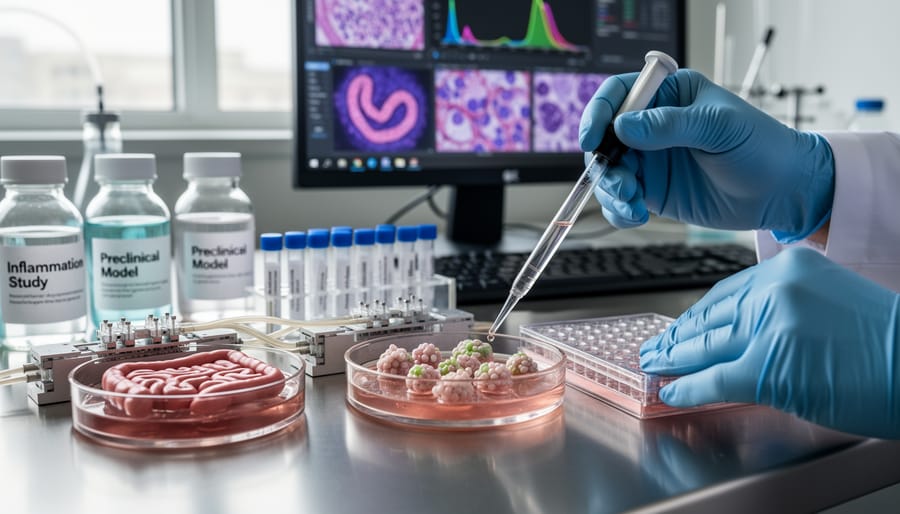
In the lab, KPV works mostly as a research tool. Scientists use it to probe how inflammation signals travel, adding it to cell cultures or giving it to animal models and watching which markers rise or fall. Think of it as a small lantern carried down a dark corridor: it doesn’t build the map, but it shows where the paths run. If you enjoy learning by doing, the way you might with well-designed interactive exhibits you can think of these experiments as hands-on tests of a single idea.
Interest has clustered around two settings: the gut and the skin. Intestinal inflammation models, such as colitis in animals, are popular because the PepT1 transporter is abundant in inflamed intestinal tissue. Skin models appeal for a simpler reason, since topical delivery keeps the peptide close to where it might act. Researchers have also discussed other routes, including oral formulations designed to survive digestion and carriers that help peptides reach their target. These remain ideas under study, not settled methods.
It matters to be plain about status. KPV is investigational. It is not an approved medicine, and the supplements and “research peptides” sold online are not the same as a tested, regulated drug. Their purity, dose and contents can vary, and nothing about a product listing proves it works in people. If you’re curious about any peptide, talk with a qualified health professional first.
Much of the map is still blank:
– What doses, if any, are meaningful in humans?
– How well does the peptide survive digestion and reach its target?
– Do results from animal models carry over to people?
– What do long-term safety and side effects look like?
– Which delivery routes, if any, will prove practical?
Until large, well-designed human studies arrive, these territories stay unexplored.
Common Questions About KPV and Inflammation Research
Readers tend to arrive at this topic with the same handful of questions, so here are plain answers to them. Keep in mind that the research is still early, and nothing here is medical advice.
What does KPV stand for, and is it the same as alpha-MSH?
KPV is the shorthand for three amino acids in sequence: lysine (K), proline (P) and valine (V). It is not the same as alpha-MSH, the larger hormone it comes from. KPV is only a small fragment taken from the tail end of that molecule.
Has KPV been proven to work in humans?
No. Most published work comes from cell cultures and animal models, and large human clinical trials are lacking. Findings from the lab are a starting point, not proof of benefit for people.
Is KPV an approved drug?
It is not an approved medicine. It remains an investigational research compound, and products sold online are not the same as regulated therapies.
How is KPV different from other peptides?
Its main distinction is its tiny size and its link to melanocortin signalling. Researchers have studied it specifically for effects on inflammatory pathways, whereas other peptides are explored for very different roles.
Where can I find the original studies?
Search a free database such as PubMed using terms like “KPV tripeptide” or “alpha-MSH fragment inflammation.” Reading the abstracts and methods yourself is the best way to see what was actually tested and in which model.
If you want to go deeper, start with the primary papers rather than summaries, and bring any health questions to a qualified professional.
Historians rarely get the whole story handed to them. They work from fragments: a worn ledger, a faded map, a fireplace stone that doesn’t match the rest of the wall. Slowly, with patience and plenty of second-guessing, a picture emerges. The story of KPV is being assembled much the same way, one study at a time.
What we have so far is a promising outline. KPV is a tiny tripeptide that researchers have examined for its effects on inflammation signalling, particularly the NF-kB and MAPK routes that switch inflammatory genes on. Cell cultures and animal models have shown encouraging patterns, and those patterns are worth following. But they are early fragments, not a finished chapter. The evidence is mostly preclinical, lab models don’t always translate to people, and large human trials are still missing.
So the wisest posture is curious patience. If you want to dig deeper, go to the primary sources: the published studies themselves, not the summaries or sales pages built around them. And if you’re considering any peptide for your own health, talk with a qualified healthcare professional first.
Science, like history, rewards those who take the long view. If this journey through the body’s inflammatory trails has you in an exploring mood, there are plenty of other trails waiting on this site, including our look at preserving the past and the landmarks that keep it alive.
