
A brief history of ancient Greece is a condensed narrative that traces the political, social, and cultural development of Greek civilization from the Bronze Age through the Hellenistic period, distilling roughly 2,000 years into an accessible framework for modern readers. These compact accounts don’t simply compress dates and battles into smaller packages. They require careful selection of defining moments, representative figures, and enduring institutions that shaped Western thought, democracy, philosophy, and art.
The search for such condensed histories often leads to foundational texts like Sarah B. Pomeroy, Stanley M. Burstein, Walter Donlan, and Jennifer Tolbert Roberts’ “A Brief History of Ancient Greece: Politics, Society, and Culture,” published by Oxford University Press in 2004. This work exemplifies the genre’s challenge: how do you capture the philosophical revolution of Socrates, the military genius of Alexander, the architectural triumph of the Parthenon, and the birth of democracy in Athens without reducing each to a footnote? The answer lies in thematic coherence rather than encyclopedic coverage.
Understanding how historians construct these brief accounts reveals why ancient Greece continues to command attention in 2026. The civilization that gave us the Olympic Games, tragic drama, and rational inquiry into the natural world didn’t emerge overnight. It evolved through distinct phases, from the palace cultures of Minoan Crete and Mycenaean Greece through the Dark Ages, into the Classical golden age, and finally into the cosmopolitan Hellenistic world after Alexander’s conquests.
This article maps the structure and content of brief Greek histories, examining what gets included, what gets left out, and how these editorial choices shape our contemporary understanding of a civilization that ended millennia ago but never stopped influencing how we think, govern, and create.
What ‘A Brief History of Ancient Greece’ Means
A brief history of ancient Greece is a condensed scholarly narrative that traces the arc of Greek civilization from the Bronze Age collapse around 1200 BCE through the Hellenistic period ending in the first century BCE. This approach doesn’t catalogue every event or ruler, but instead weaves together political transformations, social structures, and cultural achievements into a coherent story accessible to readers without specialized training. The goal is synthesis rather than encyclopedic coverage, giving you the essential framework to understand how Greece shaped Western civilization.
What sets a brief history apart from exhaustive academic studies is deliberate selectivity. Where a multivolume reference work might dedicate chapters to individual city-states or decades-long conflicts, a brief history identifies pivotal moments: the emergence of the polis, Athens’ democratic experiment, the Persian Wars, Alexander’s conquests. It connects these events to broader patterns rather than dwelling on granular detail. You get the narrative arc without getting lost in scholarly debates about dating pottery shards or interpreting fragmentary inscriptions.
- Brief History
- A selective narrative spanning major periods and themes, designed for accessibility without sacrificing accuracy. Prioritizes narrative flow over comprehensive detail.
- Comprehensive Survey
- A broader academic treatment covering more territory than a brief history but still maintaining readability for non-specialists. Balances depth with scope across multiple topics.
- Thematic History
- An approach organized around specific subjects like warfare, religion, or gender rather than chronological progression. Explores concepts across different time periods.
- Chronological Narrative
- A time-ordered account following events sequentially from earliest evidence to later periods. Emphasizes cause-and-effect relationships between successive developments.
This condensed format serves modern learners particularly well because it mirrors how most of us actually encounter ancient Greece, through its lasting influence rather than as isolated specialists. A Brief History of Ancient Greece provides the connective tissue between Homer’s epics, Athenian democracy, and Hellenistic science without requiring years of study. You can grasp why Greek philosophy still matters, how ancient warfare evolved, and what daily life looked like for citizens and slaves alike, all within a manageable framework that respects both the evidence and your time.
The brief history model recognizes that understanding ancient Greece matters less as an exercise in memorization than as a lens for seeing how societies develop, how ideas spread, and how the past continues shaping the present.
How Ancient Greek Historical Narratives Are Constructed
The Role of Primary and Secondary Sources
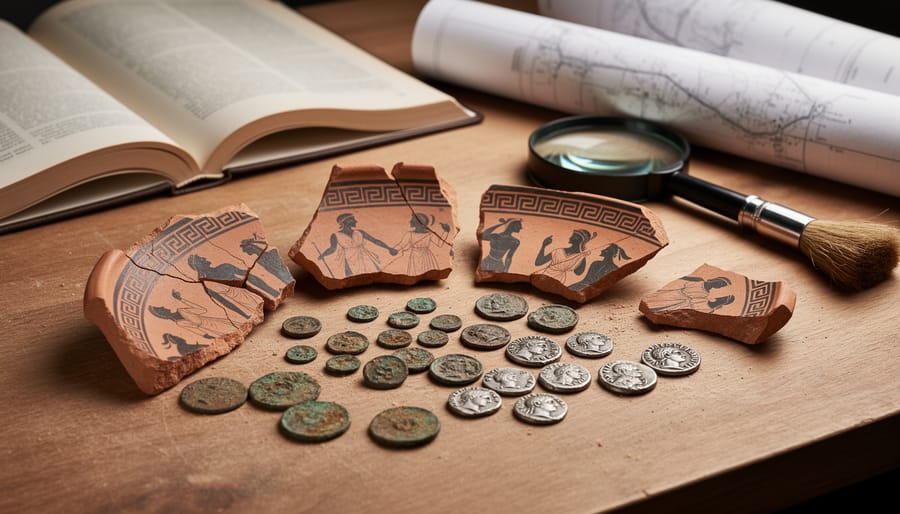
Historians reconstruct ancient Greece by weaving together primary sources, direct evidence from the period itself, with secondary sources that interpret and contextualize those materials. Primary sources include literary works like Homer’s epics and the histories of Herodotus and Thucydides, which offer contemporary perspectives despite their inherent biases. Inscriptions carved in stone provide official decrees, treaties, and civic records that reveal governance and social structures. Material culture, from pottery shards to temple ruins, speaks volumes about daily life, trade networks, and religious practices.
Methodology and sources in ancient Greek history require careful triangulation. A single text might reflect elite male perspectives, so historians cross-reference it with archaeological evidence and inscriptions to capture broader societal patterns. Secondary scholarship synthesizes these fragments, identifying patterns and filling gaps through reasoned interpretation. The challenge lies in distinguishing reliable accounts from propaganda or myth, particularly when sources contradict each other. Modern brief histories distill this complex process, presenting findings backed by multiple evidence types rather than relying on any single source, however compelling it might seem on its own.
Balancing Breadth and Depth
Creating a brief history means authors must make strategic sacrifices. They can’t examine every minor city-state’s political evolution or trace each philosophical school’s development across centuries. Instead, they prioritize events and themes that most effectively illustrate broader patterns, Athens and Sparta represent contrasting political models, the Persian Wars demonstrate Greek unity under pressure, and Socrates embodies classical intellectual inquiry.
The authors of the Oxford text chose to organize their narrative around politics, society, and culture rather than strict chronology alone. This thematic layering allows readers to grasp connections between warfare and civic identity, or between economic changes and artistic production, without getting lost in exhaustive timelines. A specialized monograph might dedicate two hundred pages to Athenian democracy’s procedural mechanisms; a brief history explains its core principles and significance in twenty.
This editorial restraint serves accessibility. Footnotes remain selective, focusing on essential sources rather than comprehensive bibliographies. Maps highlight major sites without overwhelming detail. The goal is understanding the arc of Greek civilization, from Bronze Age palaces through classical achievements to Hellenistic transformation, not mastering every archaeological debate. What readers lose in granular detail, they gain in coherent narrative flow that makes ancient Greece comprehensible rather than daunting.
Core Elements of Ancient Greek History
Political Structures and Governance
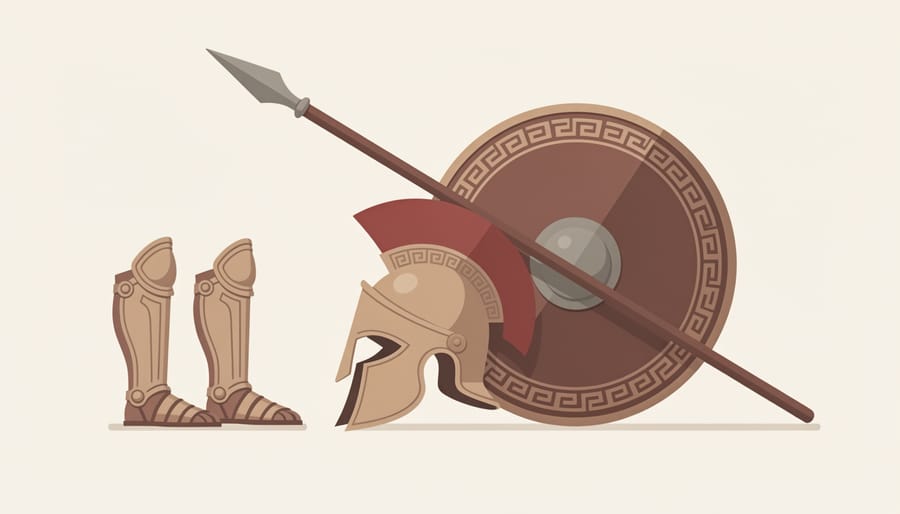
Ancient Greece’s political evolution represents one of history’s most dramatic governmental transformations. Early Bronze Age societies operated under monarchical systems, where kings ruled city-states with absolute authority backed by divine legitimacy and warrior aristocracies. The collapse of Mycenaean civilization around 1100 BCE triggered the Dark Ages, from which emerged the polis, the independent city-state that became Greece’s defining political unit.
By the Archaic period, many poleis transitioned through oligarchy, where small groups of wealthy landowners controlled governance. Athens’ gradual shift toward democracy between the sixth and fifth centuries BCE created a revolutionary system where male citizens participated directly in legislative assemblies and law courts. This participatory model, though excluding women, slaves, and foreigners, established principles that echo through modern governance.
Sparta developed a contrasting dual-kingship system balanced by a council of elders and ephors, prioritizing military discipline over individual freedoms. These competing models, Athenian democracy versus Spartan oligarchy, shaped conflicts like the Peloponnesian War and continue to inform ancient history trivia about political experimentation.
Alexander the Great’s conquests dissolved the classical polis structure, replacing it with Hellenistic monarchies that blended Greek governance with Persian administrative systems. These vast kingdoms centralized power under divine rulers, ending the democratic experiments that had defined the classical age but spreading Greek political concepts across three continents.
Social Organization and Daily Life
Ancient Greek society operated through rigid hierarchies that shaped every aspect of daily existence. At the top stood citizens, freeborn males who could vote, own property, and participate in civic life. Below them were metics (resident foreigners) who contributed economically but lacked political rights, then freedmen who had earned or purchased their liberty. At the foundation sat enslaved people, who could number a third or more of a city-state’s population and performed labor ranging from household tasks to mine work.
Women’s status varied by region but remained legally subordinate everywhere. In Athens, citizen women managed households and raised children but stayed largely confined to domestic spaces. Spartan women enjoyed more freedom, owning property, receiving physical education, and managing estates while men trained for war. Marriage served as an alliance between families rather than a romantic partnership, typically arranged when girls reached their mid-teens.
The oikos (household) formed the basic social unit, extending beyond the nuclear family to include enslaved individuals, elderly relatives, and sometimes unmarried siblings. Community life centered on the agora (marketplace), religious festivals, and symposia, drinking parties where men discussed philosophy, politics, and poetry. These gatherings reinforced social bonds among citizens while excluding women and non-citizens, reflecting the deeply stratified nature of Greek social organization.
Cultural and Intellectual Achievements
Ancient Greece produced cultural achievements that remain foundational to Western civilization. Philosophy emerged as a distinct discipline through Socrates’ dialectical method, Plato’s theory of forms, and Aristotle’s systematic approach to logic, ethics, and natural science. These thinkers established frameworks for rational inquiry that continue to shape how we analyze complex problems today.
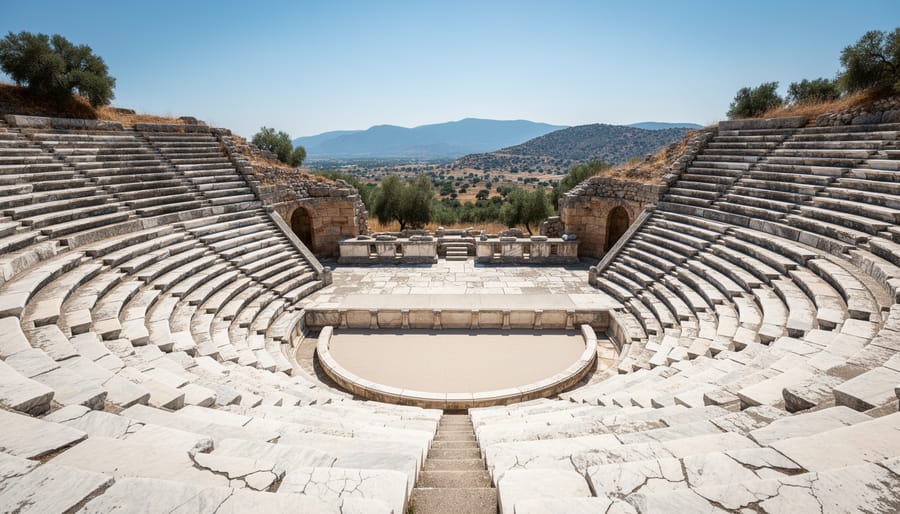
Greek drama evolved from religious festivals into sophisticated theatrical forms. Tragedians like Sophocles and Euripides explored moral dilemmas and human suffering, while Aristophanes used comedy to critique politics and social norms. The amphitheater design and three-act structure they developed still influence modern storytelling.
In visual arts, Greek sculptors perfected anatomical realism and created the classical ideal of human beauty. The Parthenon exemplifies how architecture combined mathematical precision with aesthetic harmony, establishing proportional systems that architects reference centuries later. Pottery evolved from functional craft to narrative art, documenting daily life and mythology.
These achievements weren’t isolated innovations but interconnected expressions of a culture that valued excellence, inquiry, and public discourse. Greek intellectuals moved freely between disciplines, applying geometric principles to temple design and philosophical concepts to political theory, creating a holistic cultural legacy.
How Brief Histories of Ancient Greece Are Used Today
Educational Foundations
Brief histories of ancient Greece function as essential educational tools precisely because they distill centuries of complex civilization into manageable frameworks. University courses regularly assign these texts as foundational readings that establish chronological literacy before students tackle specialized topics like Athenian democracy or Hellenistic philosophy. The comprehensive yet condensed format allows instructors to ensure all students share baseline knowledge of key periods, figures, and concepts.
Beyond formal academia, these works serve lifelong learners seeking structured entry points into classical civilization. Retirees, heritage enthusiasts preparing for Mediterranean travel, and professionals broadening their cultural literacy find brief histories provide context without overwhelming detail. The narrative approach mirrors how sites like Historic Places Day programs introduce local heritage, offering curated stories that spark deeper curiosity rather than exhaustive documentation.
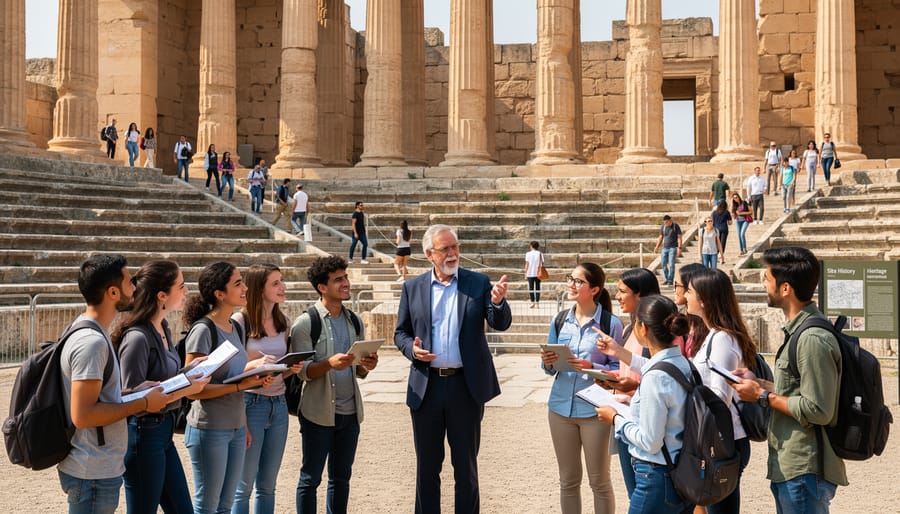
The accessibility of texts like the Oxford volume also makes them ideal companions for museum visits and archaeological site tours. Readers gain interpretive frameworks that transform ruins into meaningful historical landscapes, connecting architectural fragments to the political struggles and cultural achievements that shaped them.
Connecting Past to Present
Ancient Greece’s democratic experiments, civic participation models, and philosophical debates about justice continue to inform how modern societies structure government and protect individual rights. When we study Athenian assembly procedures or Spartan communal decision-making, we’re examining the foundations of contemporary legislative systems and public deliberation. Educational tools like virtual field trips now connect classical history with heritage sites worldwide, from L’Anse aux Meadows to Greek Revival architecture in Canadian cities. Understanding ancient citizenship concepts helps us evaluate current debates about voting rights, civic duty, and the balance between individual freedom and collective responsibility, questions the Greeks grappled with 2,500 years ago that remain urgent today.
The Oxford Text: A Landmark in Greek Historical Scholarship
When Oxford University Press published “A Brief History of Ancient Greece: Politics, Society, and Culture” in 2004, the volume immediately distinguished itself through an unusually collaborative approach. Sarah B. Pomeroy, Stanley M. Burstein, Walter Donlan, and Jennifer Tolbert Roberts each brought specialized expertise to the project, Pomeroy’s pioneering work on women’s history, Burstein’s knowledge of the Hellenistic world, Donlan’s understanding of early Greek society, and Roberts’ focus on Athenian democracy. Rather than dividing chapters among authors, they integrated their perspectives into a unified narrative that treats political developments, social structures, and cultural achievements as interconnected rather than isolated topics.
This integrated methodology proved revolutionary for undergraduate education. Earlier textbooks typically segmented Greek history into discrete chapters on politics, then art, then philosophy, forcing students to mentally reconnect these artificial divisions. The Oxford text weaves these dimensions together as they actually occurred, examining how democratic reforms influenced dramatic competitions, how military campaigns shaped philosophical inquiry, how economic systems affected family structure. A student reading about the Persian Wars encounters not just battle strategies but also the cultural confidence and artistic innovation those victories sparked.
The book’s structure mirrors how historians actually reconstruct ancient life. Each chapter balances literary sources with archaeological evidence, incorporates recent scholarship without overwhelming general readers, and acknowledges debates without disappearing into academic hedging. The authors treat the Greek world as dynamic rather than static, showing how institutions evolved, how social norms shifted across regions and centuries, and how cultural achievements built upon earlier foundations. This approach proved particularly valuable for students who’d later study Canadian heritage history where similar integration of indigenous traditions, colonial influences, and evolving governance structures reveals deeper historical patterns.
The text became standard in college courses because it respects both the complexity of Greek civilization and the needs of newcomers to ancient history. It doesn’t oversimplify, but it explains clearly. It covers chronology thoroughly, from Bronze Age Crete through Alexander’s conquests, while maintaining thematic coherence. Twenty years after publication, the Oxford volume remains influential precisely because it demonstrated how collaborative scholarship could produce accessible yet rigorous historical narrative, setting a model that subsequent brief histories have struggled to match.
Connections to Canadian Historical Exploration
Studying ancient Greece and exploring Canadian heritage share a fundamental approach: both rely on piecing together physical evidence, written records, and cultural artifacts to understand how past societies shaped the present. The same analytical skills that reveal patterns in Greek political evolution apply when interpreting Canada’s layered colonial, Indigenous, and immigrant histories. This cross-cultural historical methodology strengthens our ability to read landscapes, architecture, and community traditions as living documents.
Greek Revival architecture stands as the most visible connection between classical civilization and Canadian built heritage. From the neoclassical columns adorning legislative buildings in Victoria and Halifax to the pediments gracing courthouse facades across Ontario, these structures reflect 19th-century Canada’s deliberate alignment with Athenian democratic ideals. When you examine these buildings today, you’re witnessing how Canadian leaders borrowed Greek architectural language to project legitimacy and civic virtue. The same interpretive approach used to understand the Parthenon’s political symbolism helps decode why a young dominion chose Doric columns for its institutions of governance.
Canadian universities preserve another strand of this classical legacy. McGill, the University of Toronto, and other established institutions embedded Greek and Latin in their founding curricula, modeling themselves on British educational traditions that traced back to Hellenic scholarship. This academic lineage created generations of Canadian thinkers trained in classical rhetoric, philosophy, and historical analysis, directly influencing how the country developed its legal systems and public discourse.
Greek immigration waves from the 1950s through the 1970s added cultural depth to these architectural and academic connections. Communities in Montreal, Toronto, and Vancouver brought living traditions that echo ancient practices, communal festivals, Orthodox religious observances, culinary heritage. Understanding ancient Greek social structures and community organization enriches appreciation for how these immigrant groups maintained cultural identity while integrating into Canadian society, creating a bridge between Bronze Age village life and modern urban ethnic neighborhoods.
Frequently Asked Questions
What is “A Brief History of Ancient Greece: Politics, Society, and Culture”?
It’s a comprehensive yet accessible textbook published by Oxford University Press in 2004 that synthesizes political, social, and cultural dimensions of Greek civilization from the Bronze Age through the Hellenistic period. The work has become a standard undergraduate text for introducing students to ancient Greek history through an integrated approach.
Who wrote this landmark text?
Sarah B. Pomeroy, Stanley M. Burstein, Walter Donlan, and Jennifer Tolbert Roberts collaborated as authors, bringing complementary expertise in different aspects of ancient Greek society. Their combined perspectives allow the text to balance political narrative with social history and cultural achievements.
How does a brief history differ from a comprehensive survey?
A brief history makes strategic editorial choices to highlight pivotal events, key figures, and defining cultural moments rather than exhaustively documenting every detail. This approach prioritizes clarity and narrative flow, making the material accessible to general readers and students while maintaining scholarly rigor.
What time periods does ancient Greek history typically cover?
Most brief histories span from the Bronze Age Minoan and Mycenaean civilizations (roughly 3000-1100 BCE) through the classical period of Athens and Sparta, concluding with Alexander’s conquests and the Hellenistic kingdoms that followed. This timeframe captures the rise, flourishing, and transformation of Greek civilization over more than two millennia.
Understanding these foundational questions helps you approach Greek history with realistic expectations. A brief history won’t answer every specialized query about pottery styles or provincial governance, but it will give you the chronological framework and thematic understanding needed to explore specific interests later.
When choosing a brief history for your purposes, consider whether you need a general introduction or one slanted toward particular themes. The Oxford text balances all three dimensions, politics, society, culture, making it ideal for readers who want a rounded perspective rather than just military campaigns or just philosophy. Other brief histories might emphasize warfare, focus on democratic institutions, or highlight women’s roles depending on the authors’ priorities.
If you’re studying Greek history to better understand connections to Canadian heritage sites with classical architecture or Greek immigrant communities, a brief history provides the cultural literacy to recognize references and appreciate influences. You’ll grasp why certain building styles evoke democracy, which myths shaped Western literature, and how ancient social structures still echo in modern institutions.
A brief history of ancient Greece offers more than a condensed timeline of battles and dynasties. It serves as a bridge between distant civilizations and our modern world, revealing how concepts we take for granted, democracy, citizenship, theatrical performance, philosophical inquiry, took shape thousands of years ago. When approached with both scholarly rigor and accessible prose, these condensed narratives become powerful tools for understanding not just Greek antiquity, but the foundations of Western thought itself.
Whether you encounter Greek history through a university seminar, a museum exhibition, or while planning heritage-focused travel, the brief history format provides the essential framework you need. It distills complex social structures, political evolution, and cultural achievements into a coherent story without sacrificing accuracy. The result is an invitation rather than a barrier, a starting point that encourages you to dig deeper, ask harder questions, and make connections across time and geography.
Greek civilization continues to shape contemporary institutions, from our parliamentary systems to our educational traditions. By engaging with well-crafted historical narratives, you gain more than knowledge of the past. You develop the critical thinking skills needed to interpret how ancient ideas evolve, adapt, and resurface in modern contexts. That understanding enriches everything from visiting classical archaeological sites to participating meaningfully in democratic life today. The story of ancient Greece, when told well, remains perpetually relevant.
