
Stand at the windswept edge of Newfoundland’s northern peninsula, where weathered Norse foundations pierce through wild grasses, and you’ll find yourself at the only authenticated Viking settlement in North America. Five centuries before Columbus set sail, Norse explorers crossed the Atlantic and built workshops, dwellings, and a smithy on these shores around 1000 CE. What they left behind would remain hidden for nearly a millennium, preserved beneath layers of peat and coastal vegetation, waiting to rewrite the story of European contact with the Americas.
The discovery of L’Anse aux Meadows in 1960 by Norwegian explorer Helge Ingstad and archaeologist Anne Stine Ingstad transformed our understanding of transatlantic exploration. Those careful excavations revealed iron rivets, a bronze cloak pin, stone tools, and the unmistakable post holes of Norse longhouses. Each artifact confirmed what medieval sagas had long suggested: Vikings didn’t just raid European coastlines, they ventured far beyond Greenland to establish a foothold in what they called Vinland.
Today, this UNESCO World Heritage Site invites you into an extraordinary moment of cultural collision. Walk through reconstructed sod buildings where costumed interpreters demonstrate Viking-age crafts. Examine the archaeological remains where Norse timber met North American soil. Consider the indigenous peoples who already called these lands home for thousands of years before Viking keels scraped onto these beaches.
This remote site challenges simple narratives about discovery and settlement. It stands as testimony to human ambition, intercontinental connections, and the complex layers of history that shaped the North Atlantic world long before European colonization transformed two continents forever.
A Thousand-Year-Old Secret Revealed
For centuries, scholars dismissed the Norse sagas as mere legend, beautiful stories with no basis in archaeological fact. That certainty crumbled in the early 1960s when Norwegian explorer Helge Ingstad and his wife, archaeologist Anne Stine Ingstad, arrived at a windswept peninsula on Newfoundland’s northern tip, following clues hidden in medieval texts and local knowledge.
Helge had spent years tracing possible Viking routes along the North American coast, guided by saga descriptions of “Vinland.” When he reached the fishing village of L’Anse aux Meadows, a local resident named George Decker showed him curious grass-covered ridges near Black Duck Brook. These weren’t natural formations, the Ingstads realized. They were Norse house foundations.
What followed was eight seasons of meticulous excavation, discovered in 1960, that would rewrite North American history. Anne Stine led the archaeological team with exacting precision, carefully documenting each layer of peat and soil. The site yielded treasures that silenced the skeptics: a bronze ring-headed pin identical to those found in Norse graves, a stone lamp of Icelandic type, iron boat rivets, and butternuts that don’t grow this far north, suggesting voyages even further south.
The moment we uncovered the first Norse artifacts, we knew we had found something that would change how the world understood early exploration of the Americas.
The most convincing evidence came from the buildings themselves. Eight structures followed distinctively Norse architectural patterns, with thick turf walls and the characteristic long-hall design found across the Viking world. A specialized smithy contained slag from bog iron smelting, a uniquely Norse metalworking technique. Radiocarbon dating placed human occupation firmly around 1000 CE, exactly when the sagas claimed Leif Erikson reached these shores.
International experts arrived to verify the findings. By 1968, the evidence was irrefutable. Vikings had indeed reached North America five centuries before Columbus, establishing the first known European settlement on the continent. The discovery transformed L’Anse aux Meadows from an isolated fishing community into a window through which we could finally glimpse the remarkable scope of Viking maritime achievement and courage.
Walking Through a Viking Settlement
The Reconstructed Norse Buildings
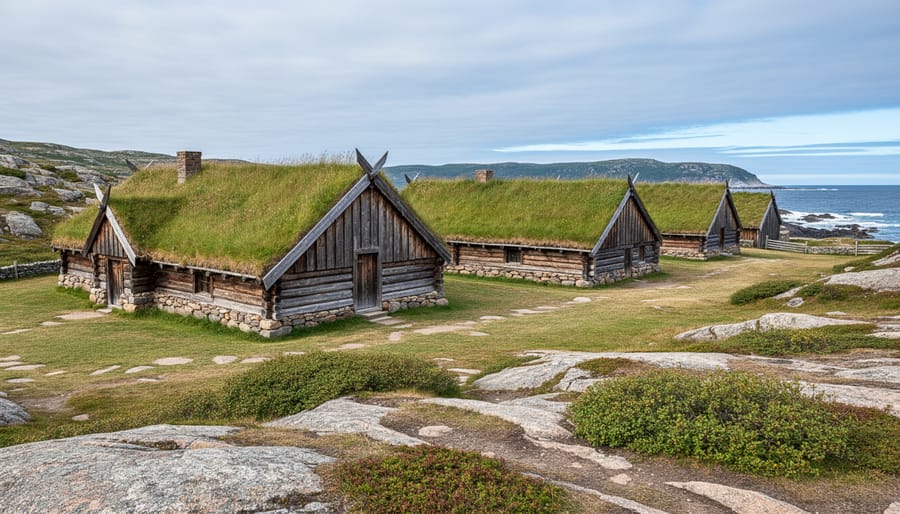
Walking through the entrance of the reconstructed Norse settlement, visitors step back nearly a millennium into a world of turf walls and dim interiors. The three carefully rebuilt sod buildings at L’Anse aux Meadows stand as tangible connections to the Viking explorers who briefly called this windswept shore home around the year 1000 CE.
Each structure showcases the remarkable construction techniques Norse settlers developed for survival in harsh northern climates. Thick walls of layered sod, stacked over wooden frames, provided impressive insulation against Newfoundland’s biting winds. The turf, cut in rectangular blocks from nearby meadows, created walls nearly a meter thick. Inside, rough-hewn timber beams support the roof structure, while the earthen floors have been packed hard underfoot, just as they would have been through daily use a thousand years ago.
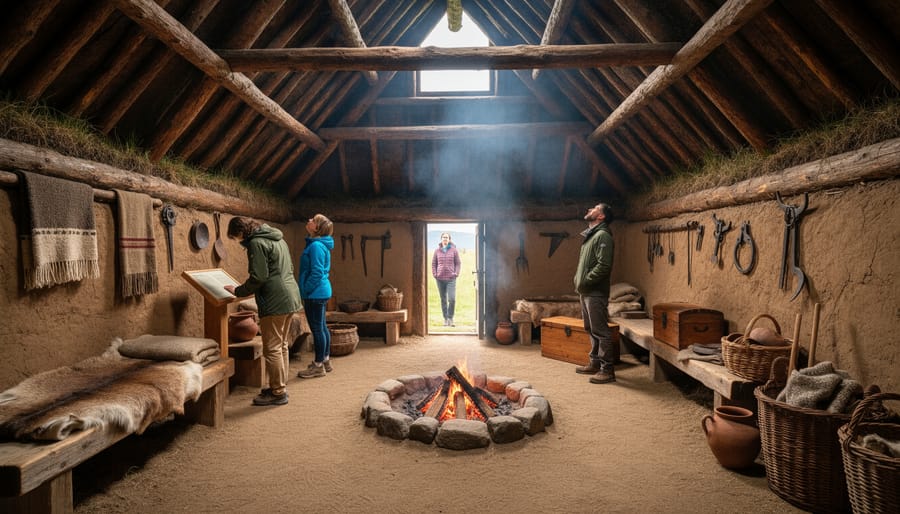
The largest building served as a communal hall, where archaeological evidence suggests both living and working occurred. As your eyes adjust to the low light filtering through the doorway, you can imagine Norse families gathering around the central hearth, its stone-lined fire pit providing warmth, light, and a place to prepare meals. Along the walls, raised platforms likely served as sleeping benches, covered with furs and wool blankets.
The second structure functioned as a specialized workshop, particularly for iron smithing. Charcoal stains and slag deposits found during excavations revealed where Norse craftspeople repaired tools and produced small iron rivets for boat repairs. The third building likely served as a combination storage facility and additional workshop space.
These reconstructions transform archaeological evidence into lived experience, allowing visitors to duck through low doorways, touch rough sod walls, and imagine the daily rhythms of Viking life on North America’s edge.
The Archaeological Remains
Walking among the grassy depressions at L’Anse aux Meadows feels like stepping into a thousand-year-old blueprint. Eight distinct building foundations mark the landscape, their turf-walled outlines carefully excavated and preserved to reveal the footprint of Norse occupation. These aren’t grand structures, but rather functional buildings that speak to the pragmatic nature of Viking explorers: three large hall dwellings where families lived and worked, plus smaller structures serving as workshops and storage facilities.
The largest dwelling measured roughly 28.8 by 15.6 meters, its thick sod walls once topped with a timber frame and turf roof. Inside these halls, archaeologists discovered evidence of everyday Viking life: stone hearths positioned at the building’s center, ember pits for keeping fires alive overnight, and post holes indicating where timber supports once stood. The layout mirrors buildings found in Norse Greenland and Iceland, confirming these weren’t temporary shelters but established living spaces.
But it was the artifacts that transformed speculation into certainty. A bronze ringed pin used to fasten Viking cloaks, a bone needle, iron boat rivets, and a spindle whorl for spinning wool all bore unmistakable Norse characteristics. Perhaps most telling was the discovery of iron slag and a stone anvil in the smithy, proving metalworking activities. Indigenous peoples of this region didn’t smelt iron, making this evidence irrefutable proof of European presence five centuries before Columbus.
The Vikings Who Made It Here
Around the year 1000 CE, a small group of Norse settlers made the extraordinary journey from Greenland across the treacherous North Atlantic, becoming the first documented Europeans to set foot in North America. Led by Leif Erikson, son of the infamous Erik the Red who had established Greenland’s Norse colonies, these adventurers followed stories of land glimpsed to the west by earlier sailors blown off course.
The Icelandic Sagas, particularly the Saga of the Greenlanders and the Saga of Erik the Red, preserve these remarkable voyages in vivid detail. According to these medieval texts, Leif Erikson sailed west from Greenland and discovered three distinct lands: Helluland (likely Baffin Island), Markland (probably Labrador), and finally Vinland, a place described as abundant with wild grapes, salmon, and timber. The archaeological evidence at L’Anse aux Meadows confirms that these weren’t mere legends but actual historical events.
- Vinland
- The Norse name for the lands they discovered in North America, meaning “wine land” or possibly “meadowland,” characterized in the sagas as a place of plenty with valuable resources.
- Leif Erikson
- The Norse explorer credited with leading the first documented European expedition to North America around 1000 CE, establishing the settlement that archaeological evidence suggests was L’Anse aux Meadows.
- Freydís Eiríksdóttir
- Leif Erikson’s fierce half-sister who, according to the sagas, led her own expedition to Vinland, demonstrating that Viking women actively participated in exploration and settlement efforts.
- Straumfjǫrðr
- One of the settlement locations mentioned in the sagas, possibly referring to L’Anse aux Meadows itself, described as a base camp for further exploration.
The Norse came seeking resources that Greenland desperately lacked: timber for shipbuilding, iron ore, and new lands for farming. L’Anse aux Meadows served as a gateway settlement, a repair station and exploration base rather than a permanent colony. Evidence suggests they stayed for only a few years, perhaps a decade at most.
Why didn’t they remain? The sagas hint at conflicts with Indigenous peoples they called Skraelings, likely ancestors of modern Indigenous groups. The settlement’s remote location, over 3,500 kilometers from Greenland, made supply lines impossibly long. Without reinforcements and facing resistance from established populations, these Norse pioneers eventually sailed home, leaving behind only whispers in oral tradition and the timber remains that would sleep undiscovered for nearly a millennium.
What the Artifacts Tell Us
The Norse artifacts discovered at L’Anse aux Meadows tell a remarkably intimate story of Viking life a thousand years ago. Each object recovered from the soil serves as a window into the daily activities, skills, and social structures of these Norse explorers who briefly called Newfoundland home.
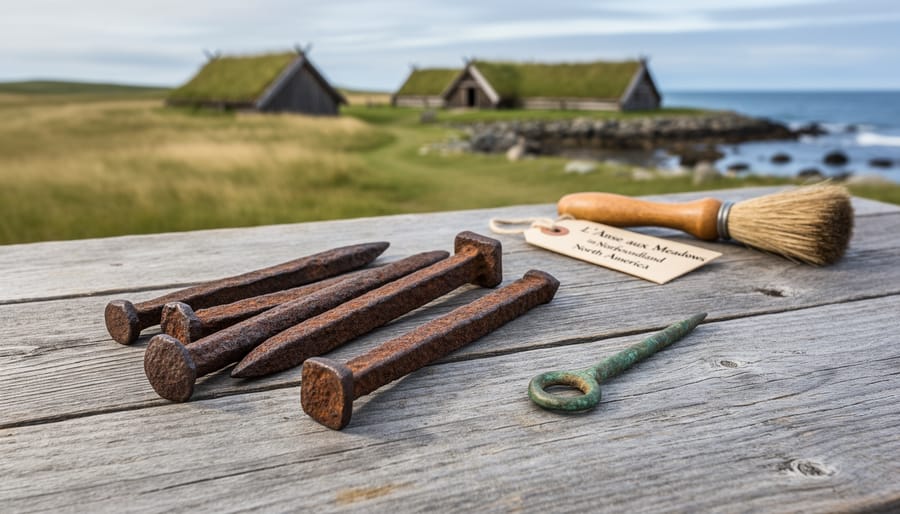
Among the most significant finds are iron boat nails, small but mighty pieces of evidence that confirm the Norse presence beyond doubt. These hand-forged nails reveal sophisticated metalworking knowledge and the Vikings’ reliance on their ships, not just for ocean crossings but as integral parts of their material culture. The discovery of iron slag and a forge demonstrates something even more remarkable: the Vikings didn’t simply bring finished metal goods across the Atlantic. They actively worked iron at the site, heating and hammering raw materials into essential tools and nails needed for repairs and construction.
A delicate bronze ring-headed pin speaks to personal adornment and the preservation of cultural identity even in this remote outpost. Vikings used such pins to fasten their cloaks, and this small ornament suggests the occupants maintained their traditional dress and customs despite being thousands of miles from Scandinavia.
Perhaps the most evocative artifact is a soapstone spindle whorl, a simple weighted disk used in spinning yarn from wool. This unassuming object provides concrete evidence that women lived and worked at L’Anse aux Meadows, transforming our understanding of the settlement from a purely male exploratory camp into a more complex community. In Norse society, textile production was typically women’s work, and the presence of spinning tools indicates domestic life and possibly the intention to establish a more permanent presence.
Worked wood fragments reveal construction techniques and woodland management, showing how the Vikings adapted to local resources while maintaining their traditional building methods. These pieces of shaped timber, some still bearing tool marks, connect us directly to the hands that crafted them.
Together, these artifacts paint a picture not of mythical warriors, but of skilled craftspeople, navigators, and families attempting to create a life in an unfamiliar land, bringing their technology, traditions, and determination to the edge of a new world.
Experiencing the Viking Heritage Today
Stepping onto the windswept grounds of L’Anse aux Meadows transports visitors back eleven centuries to when Norse explorers first landed on these shores. The experience begins at the modern interpretive center, where archaeological treasures and multimedia exhibits tell the story of both the Viking settlement and the Indigenous peoples who knew these lands long before. Here, you can examine authentic artifacts recovered from the site and understand the painstaking detective work that revealed this settlement’s secrets.
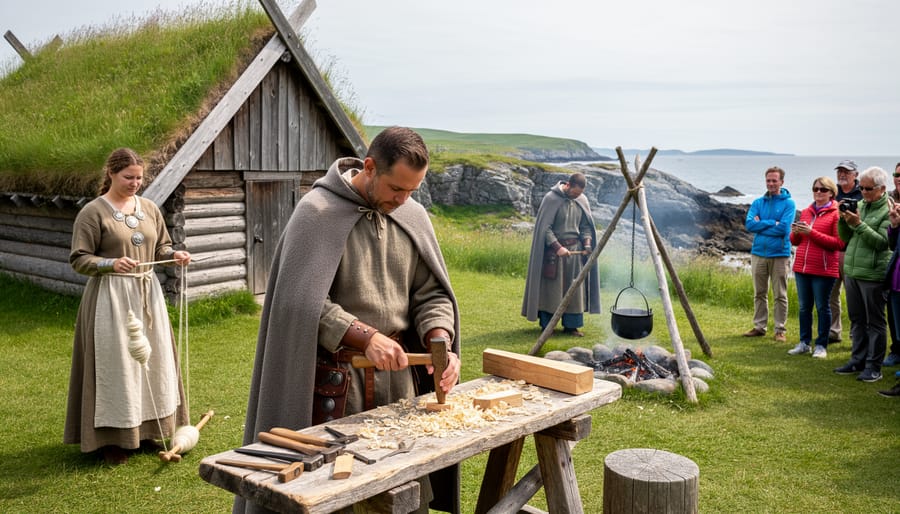
The heart of the visitor experience lies in the reconstructed Norse buildings, faithful recreations based on archaeological evidence. These turf-walled structures, with their low doorways and earthen roofs, demonstrate the ingenuity required to survive in this challenging environment. Throughout the warmer months, costumed interpreters bring the settlement to life, demonstrating traditional Viking crafts such as woodworking, metalsmithing, and textile production. Watching these skilled practitioners work with period-accurate tools offers tangible connections to daily life in the Viking age.
| Information | Details | Notes |
|---|---|---|
| Operating Season | Early June to early October | Peak season July-August |
| Best Visiting Times | Mid-morning or late afternoon | Fewer crowds, better lighting |
| Special Programs | Viking crafts, guided tours, archaeology talks | Check schedule in advance |
| Average Visit Duration | 2-3 hours | Allow extra time for trails |
Special programming enhances the experience throughout the season. Archaeological interpretation programs allow visitors to handle replica artifacts and understand excavation techniques. Evening storytelling sessions during summer months weave together Norse sagas and local histories, creating memorable connections between past and present.
The landscape itself provides profound context. Walking the coastal trails that wind around the site, you encounter the same views the Vikings saw: dramatic coastlines, rolling meadows, and the vast Atlantic stretching eastward toward Greenland and Scandinavia. This setting transforms historical understanding from abstract knowledge into lived experience, making the remarkable journey of these medieval seafarers feel both real and immediate.
The Indigenous Context: Before and After the Vikings
Long before Norse sailors glimpsed the shores of Newfoundland around 1000 CE, this landscape thrived with human presence stretching back millennia. The story of L’Anse aux Meadows exists within a far deeper narrative of Indigenous peoples who called this territory home for over 6,000 years.
When the Vikings arrived, the Dorset people likely inhabited the region. These resourceful Arctic hunters had adapted remarkably to the harsh northern climate, living in semi-subterranean houses and crafting sophisticated tools from stone, bone, and ivory. Archaeological evidence suggests the Norse encountered Indigenous peoples they called “Skraelings,” a term appearing in the Icelandic sagas. These encounters, described in the historical texts as both trading interactions and conflicts, eventually contributed to the Norse departure from North America.
The Maritime Archaic tradition represents some of the earliest known inhabitants of Newfoundland, establishing seasonal camps along the coast between 5,000 and 3,500 years ago. These skilled maritime hunters harvested seals, seabirds, and fish, developing an intimate knowledge of coastal resources that sustained communities for generations.
Following the Dorset culture, ancestors of the Beothuk people emerged as the dominant Indigenous presence in Newfoundland. For centuries, they maintained sophisticated seasonal migration patterns, moving between coastal and interior regions to harvest caribou, salmon, seals, and other resources. The Beothuk’s deep connection to this land spanned countless generations, though tragically, European colonization in later centuries devastated their population, leading to their extinction as a distinct people by the early 19th century.
Today, when visitors walk the windswept grasslands at L’Anse aux Meadows, they stand not merely at a Viking site but within a landscape bearing witness to thousands of years of human ingenuity, adaptation, and survival. The brief Norse presence represents just one chapter in a profoundly longer human story, reminding us that this place has always belonged first to those who lived here across the ages.
Standing on the windswept shores of Newfoundland’s northern tip, L’Anse aux Meadows offers more than a glimpse into the past—it provides irrefutable evidence that rewrites the story of transatlantic exploration. Five centuries before Columbus set sail, Norse seafarers navigated treacherous waters to establish their presence on North American soil, making this site a pivotal bridge between Old World ambitions and New World realities.
The reconstructed turf buildings and recovered artifacts speak to an audacious spirit of exploration that connected distant civilizations long before history books traditionally acknowledged. Here, the narratives of Indigenous peoples who witnessed these arrivals and the Vikings who dared to venture beyond known horizons converge, reminding us that human curiosity and courage know no bounds.
Visiting L’Anse aux Meadows means walking where history pivoted, touching the tangible proof of Viking ingenuity, and understanding how archaeological evidence can fundamentally reshape our perception of the past. The site invites you to become part of its continuing story—to experience the raw beauty of the landscape that challenged and inspired those early voyagers.
For site managers and cultural organizations seeking to preserve and share similar remarkable places, consider registering your historical sites to ensure these irreplaceable connections to our collective past remain accessible for future generations. L’Anse aux Meadows stands as a testament to what we can discover when we look beyond conventional narratives and embrace the full complexity of human history.
